Reference
Fundamentals
The core engineering knowledge tested in every product design interview. Quick reference formulas at the top, expandable deep dives below. Grounded in real consumer electronics, not textbook abstractions.
Statics & Strength of Materials
Every PD interview starts here. If you cannot draw a free body diagram and calculate bending stress, nothing else matters.
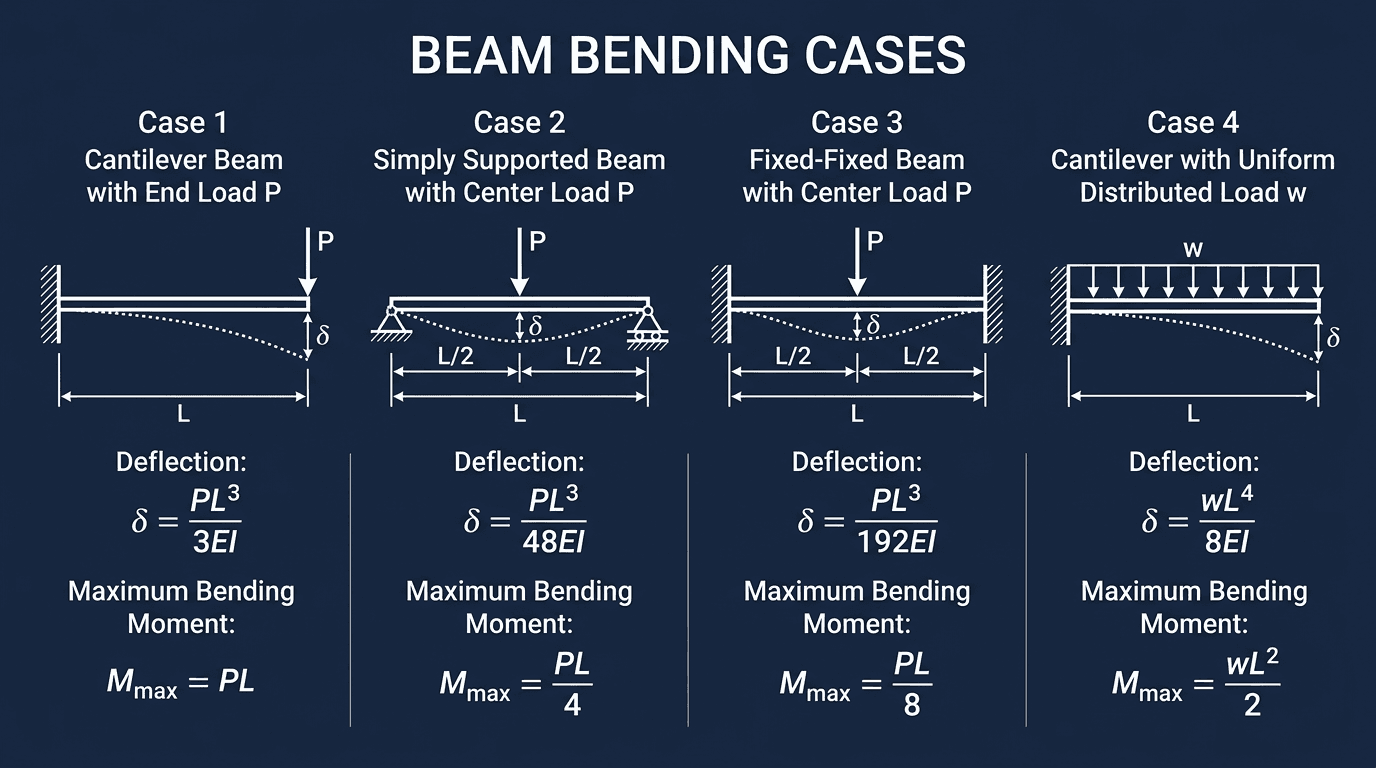
Quick Reference
Bending Stress
M = bending moment, c = distance from neutral axis, I = second moment of area
When: Evaluating whether a beam or bracket will yield under load
Deflection (Simply Supported, Center Load)
P = force, L = span, E = elastic modulus, I = second moment of area
When: Phone sit-test, display deflection check, bracket stiffness
Deflection (Cantilever, End Load)
Same as above; cantilever is 16x more flexible than simply supported
When: Snap fit deflection, button cantilever, PCB flex during assembly
Deflection (Fixed-Fixed, Center Load)
Fixed-fixed is 4x stiffer than simply supported for the same span
When: Laptop lid supported at both hinges, phone midframe with bonded display
Normal Stress
F = applied force, A = cross-sectional area
When: Tension or compression in a fastener, standoff, or strut
Shear Stress
V = shear force, Q = first moment of area, b = width at section
When: Shear in adhesive joints, snap fit bases, thin walls
Safety Factor
Consumer electronics: SF 1.5-2.0 on yield; safety-critical: SF 3.0+
When: Every structural design decision. Below 1.5 requires justification.
Moment of Inertia (Rectangular Section)
b = width, h = height. Height cubed means doubling height gives 8x stiffness.
When: Quick estimation of beam or bracket stiffness from cross-section dimensions